EXERCISE AND A GOOD NIGHTS SLEEP
Increased your physical activity is a way to cure insomnia and other sleep problems. Regular exercise
has a positive effect on sleep. Movement builds muscles, bones and connective tissue but also benefits
our internal workings like digestion. Are exercising daily? You can start today! Start slow, but never
say “I can’t do it”. Set exercise as a goal, make it attainable and then work towards a new you. Studies
show that lack of physical activity contributes to insomnia by disturbing the normal rise and fall of your body temperature.
Exercise has a beneficial effect on our circadian rhythm, (our “master body clock”) which is the brains way of telling us that it’s time to sleep or time to be awake. Working out promotes the shifts in the internal body clock, and is very effective in treating problems related to a disturbed circadian rhythm. Most commonly people with disturbed rhythms are folks that work various shifts or people who travel frequently into different time zones.
Keeping yourself active contributes to a better quality of life too. There are numerous ways to keep
active (only limited to your imagination). Take a walk, (inside a mall or shopping center) or outside (on a trail, sidewalk or in a parking lot) or visit the gym. Anything that requires exertion and movement qualifies as activity. You can become more active simply by taking stairs instead of the elevator or parking farther away from the door at work or a shopping mall.
Keep three things in mind before starting ANY exercise regimen
1. Always check with your doctor first to be sure that you are physically healthy enough to
start a new exercise program, especially people with high blood pressure, have physical
impairments that would prevent them from exercise, and those that have not exercised in a
very long time.
2. Warm up your body first. The process of warming or stretching to loosen the muscles is very
important. Cooling down is equally important after exercise to decrease the buildup of
lactic acid.
3. Determine your body’s best time to exercise. Some find it easier to work out in the EARLY
morning while others find it works better for them to work out at night. Others also find
that the middle of the day or during their lunch hour is the best time to sneak in their work
out. This may take some time to figure out, but once you do, the benefits of exercise,
physically and psychologically will become a regular part of your lifestyle and will promote a
good night’s sleep.
What types of exercises are best for a good night’s sleep?
1. Isometric—those that don’t require much body movement. Rowing or weight lifting.
2. Dynamic—Examples, playing team sports like hockey, basketball or football. These improve
physical fitness and are useful for body and brain.
3. Aerobic—the following aerobic exercises whether in a class setting or on your own will also
help in relief of insomnia. Examples, running, cycling, biking.
Use any of the above, the most important part, just do it!
For additional tips and information, please e mail val@midtown-fitness.com
Friday, February 1, 2013
Wednesday, January 16, 2013
Fitness Myths
MYTH #1: DO 8 TO 12 REPETITIONS
The claim: It's the optimal repetition range for building muscle.
The origin: In 1954, Ian MacQueen, M.D., an English surgeon and competitive bodybuilder, published a scientific paper in which he recommended a moderately high number of repetitions for muscle growth.
The truth: This approach places muscles under a medium amount of tension for a medium amount of time—it's basically The Neither Here Nor There Workout.
Here's the deal: Higher tension—a.k.a. heavier weights—induces the type of muscle growth in which the muscle fibers grow larger, leading to the best gains in strength; longer tension time, on the other hand, boosts muscle size by increasing the energy-producing structures around the fibers, improving muscular endurance. The classic prescription of 8 to 12 repetitions strikes a balance between the two. But by using that scheme all the time, you miss out on the greater tension levels that come with heavier weights and fewer repetitions, and the longer tension time achieved with lighter weights and higher repetitions.
The new standard: Vary your repetition range—adjusting the weights accordingly—so that you stimulate every type of muscle growth. Try this method for a month, performing three full-body sessions a week: Do five repetitions per set in your first workout, 10 reps per set in your second workout, and 15 per set in your third workout.
MYTH #2: DO 3 SETS OF EACH EXERCISE
The claim: This provides the ideal workload for achieving the fastest muscle gains.
The origin: In 1948, a physician named Thomas Delorme reported in the Archives of Physical Medicine that performing three sets of 10 repetitions was as effective at improving leg strength as 10 sets of 10 repetitions.
The truth: There's nothing wrong with—or magical about—doing three sets. But the number of sets you perform shouldn't be determined by a 50-year-old default recommendation. Here's a rule of thumb: The more repetitions of an exercise you do, the fewer sets you should perform, and vice versa. This keeps the total number of reps you do of an exercise nearly equal, no matter how many repetitions make up each set.
The new standard: If you're doing eight or more reps, keep it to three sets or less. If you're pounding out less than three reps, you should be doing at least six sets.
BONUS TIP: When it comes to making lifestyle changes that will improve your health, your first step is the most important one. Start here: 20 Little Changes for a Healthier Life.
MYTH #3: DO 3 OR 4 EXERCISES PER MUSCLE GROUPThe claim: This ensures that you work all the fibers of the target muscle.
The origin: Arnold Schwarzenegger, circa 1966.
The truth: You'll waste a lot of time. Here's why: Schwarzenegger's four-decade-old recommendation is almost always combined with "Do three sets of 8 to 12 repetitions." That means you'll complete up to 144 repetitions for each muscle group. Trouble is, if you can perform even close to 100 repetitions for any muscle group, you're not working hard enough.
Think of it this way: The harder you train, the less time you'll be able to sustain that level of effort. For example, many men can run for an hour if they jog slowly, but you'd be hard-pressed to find anyone who could do high-intensity sprints—without a major decrease in performance—for that period of time. And once performance starts to decline, you've achieved all the muscle-building benefits you can for that muscle group.
The new standard: Instead of focusing on the number of different exercises you do, shoot for a total number of repetitions between 25 and 50. That could mean five sets of five repetitions of one exercise (25 repetitions) or one set of 15 repetitions of two or three exercises (30 to 45 repetitions).
MYTH #4: NEVER LET YOUR KNEES GO PAST YOUR TOES
The claim: Allowing your knees to move too far forward during exercises such as the squat and lunge places dangerous shearing forces on your knee ligaments.
The origin: A 1978 study at Duke University found that keeping the lower leg as vertical as possible during the squat reduced shearing forces on the knee.
The truth: Leaning your torso too far forward, so that your knees stay back, is more likely to cause injury. In 2003, University of Memphis researchers confirmed that knee stress was 28 percent higher when the knees were allowed to move past the toes during the squat. But the researchers also found a countereffect: Hip stress increased nearly 1,000 percent when forward movement of the knee was restricted. The reason: The squatters had to lean their torsos farther forward. And that's a problem, because forces that act on the hip are transferred to the lower back, a more frequent site of injury than the knees.
The new standard: Watch a toddler squat. Push your hips back as far as you can, while keeping your torso as upright as possible. This will reduce the stress on your back and knees.
MYTH #5: WHEN YOU LIFT WEIGHTS, DRAW IN YOUR ABS
The claim: You'll increase the support to your spine, reducing the risk of back injuries.
The origin: In 1999, researchers in Australia found that some men with back pain had a slight delay in activating their transverse abdominis, a deep abdominal muscle that's part of the musculature that maintains spine stability. As a result, many fitness professionals began instructing their clients to try to pull their belly buttons to their spines—which engages the transverse abdominis—as they performed exercises.
The truth: "The research was accurate, but the interpretation by many researchers and therapists wasn't," says Stuart McGill, Ph.D., author of Ultimate Back Fitness and Performance and widely recognized as the world's top researcher on the spine. That's because muscles work in teams to stabilize your spine, and the most valuable players change depending on the exercise, says McGill. Read: The transverse abdominis isn't always the quarterback.
In fact, for any given exercise, your body automatically activates the muscles that are most needed for spine support. So focusing only on your transverse abdominis can overrecruit the wrong muscles and underrecruit the right ones. This not only increases injury risk, but reduces the amount of weight you can lift.
The new standard: If you want to give your back a supporting hand, simply "brace" your abs as if you were about to be punched in the gut, but don't draw them in. "This activates all three layers of the abdominal wall," says McGill, "improving both stability and performance."
The claim: It's the optimal repetition range for building muscle.
The origin: In 1954, Ian MacQueen, M.D., an English surgeon and competitive bodybuilder, published a scientific paper in which he recommended a moderately high number of repetitions for muscle growth.
The truth: This approach places muscles under a medium amount of tension for a medium amount of time—it's basically The Neither Here Nor There Workout.
Here's the deal: Higher tension—a.k.a. heavier weights—induces the type of muscle growth in which the muscle fibers grow larger, leading to the best gains in strength; longer tension time, on the other hand, boosts muscle size by increasing the energy-producing structures around the fibers, improving muscular endurance. The classic prescription of 8 to 12 repetitions strikes a balance between the two. But by using that scheme all the time, you miss out on the greater tension levels that come with heavier weights and fewer repetitions, and the longer tension time achieved with lighter weights and higher repetitions.
The new standard: Vary your repetition range—adjusting the weights accordingly—so that you stimulate every type of muscle growth. Try this method for a month, performing three full-body sessions a week: Do five repetitions per set in your first workout, 10 reps per set in your second workout, and 15 per set in your third workout.
MYTH #2: DO 3 SETS OF EACH EXERCISE
The claim: This provides the ideal workload for achieving the fastest muscle gains.
The origin: In 1948, a physician named Thomas Delorme reported in the Archives of Physical Medicine that performing three sets of 10 repetitions was as effective at improving leg strength as 10 sets of 10 repetitions.
The truth: There's nothing wrong with—or magical about—doing three sets. But the number of sets you perform shouldn't be determined by a 50-year-old default recommendation. Here's a rule of thumb: The more repetitions of an exercise you do, the fewer sets you should perform, and vice versa. This keeps the total number of reps you do of an exercise nearly equal, no matter how many repetitions make up each set.
The new standard: If you're doing eight or more reps, keep it to three sets or less. If you're pounding out less than three reps, you should be doing at least six sets.
BONUS TIP: When it comes to making lifestyle changes that will improve your health, your first step is the most important one. Start here: 20 Little Changes for a Healthier Life.
MYTH #3: DO 3 OR 4 EXERCISES PER MUSCLE GROUPThe claim: This ensures that you work all the fibers of the target muscle.The origin: Arnold Schwarzenegger, circa 1966.
The truth: You'll waste a lot of time. Here's why: Schwarzenegger's four-decade-old recommendation is almost always combined with "Do three sets of 8 to 12 repetitions." That means you'll complete up to 144 repetitions for each muscle group. Trouble is, if you can perform even close to 100 repetitions for any muscle group, you're not working hard enough.
Think of it this way: The harder you train, the less time you'll be able to sustain that level of effort. For example, many men can run for an hour if they jog slowly, but you'd be hard-pressed to find anyone who could do high-intensity sprints—without a major decrease in performance—for that period of time. And once performance starts to decline, you've achieved all the muscle-building benefits you can for that muscle group.
The new standard: Instead of focusing on the number of different exercises you do, shoot for a total number of repetitions between 25 and 50. That could mean five sets of five repetitions of one exercise (25 repetitions) or one set of 15 repetitions of two or three exercises (30 to 45 repetitions).
MYTH #4: NEVER LET YOUR KNEES GO PAST YOUR TOES
The claim: Allowing your knees to move too far forward during exercises such as the squat and lunge places dangerous shearing forces on your knee ligaments.
The origin: A 1978 study at Duke University found that keeping the lower leg as vertical as possible during the squat reduced shearing forces on the knee.
The truth: Leaning your torso too far forward, so that your knees stay back, is more likely to cause injury. In 2003, University of Memphis researchers confirmed that knee stress was 28 percent higher when the knees were allowed to move past the toes during the squat. But the researchers also found a countereffect: Hip stress increased nearly 1,000 percent when forward movement of the knee was restricted. The reason: The squatters had to lean their torsos farther forward. And that's a problem, because forces that act on the hip are transferred to the lower back, a more frequent site of injury than the knees.
The new standard: Watch a toddler squat. Push your hips back as far as you can, while keeping your torso as upright as possible. This will reduce the stress on your back and knees.
MYTH #5: WHEN YOU LIFT WEIGHTS, DRAW IN YOUR ABSThe claim: You'll increase the support to your spine, reducing the risk of back injuries.
The origin: In 1999, researchers in Australia found that some men with back pain had a slight delay in activating their transverse abdominis, a deep abdominal muscle that's part of the musculature that maintains spine stability. As a result, many fitness professionals began instructing their clients to try to pull their belly buttons to their spines—which engages the transverse abdominis—as they performed exercises.
The truth: "The research was accurate, but the interpretation by many researchers and therapists wasn't," says Stuart McGill, Ph.D., author of Ultimate Back Fitness and Performance and widely recognized as the world's top researcher on the spine. That's because muscles work in teams to stabilize your spine, and the most valuable players change depending on the exercise, says McGill. Read: The transverse abdominis isn't always the quarterback.
In fact, for any given exercise, your body automatically activates the muscles that are most needed for spine support. So focusing only on your transverse abdominis can overrecruit the wrong muscles and underrecruit the right ones. This not only increases injury risk, but reduces the amount of weight you can lift.
The new standard: If you want to give your back a supporting hand, simply "brace" your abs as if you were about to be punched in the gut, but don't draw them in. "This activates all three layers of the abdominal wall," says McGill, "improving both stability and performance."
Friday, January 11, 2013
50 Weight Loss Tips
1. Train using the most “bang for your buck,” multi-joint lifts like squats, deadlifts, bench press, chin-ups, and Olympic lifts. 2. Avoid isolation, single-joint lifts such as bicep or leg curls unless you have unlimited training time.
3. Use very short rest periods (10 to 60 seconds) to trigger the greatest growth hormone response.
4. Vary the tempo of lifting phases and rest periods to provide new stimulus for the body to adapt.
5. To get lean fast, use a hypertrophy-type protocol (8 to 12 reps, more than 3 sets, 70 to 85 percent 1RM load).
6. Use a longer time under tension to burn more energy and increase postexercise oxygen consumption—try a 4-second eccentric and 1-second concentric phase.
7. Train to create an anabolic response. Increasing growth hormone is the priority because of its significant lipolytic (fat burning) effects.
8. Perform circuit training with little rest between sets for maximal growth hormone response.
9. For gradual fat loss over a longer period, include strength cycles that favor testosterone release with heavier loads (up to 95 percent 1RM), slightly longer rest (2 to 3 minutes), and lots of sets.
10. Work harder. If you’re not getting results, you’re not working hard enough.
11. Give priority to training the anaerobic energy system over the aerobic system when strength training and conditioning.
12. Do high-intensity sprint intervals for conditioning. Two examples are 60 cycle sprints of 8 seconds each, 12 seconds rest; or 6 all-out 30-second running sprints on a track, 4 minutes rest.
13. Be as active as possible in daily life. Move more: Take regular brisk walks during the day, always take the stairs, park far away in any parking lot, or do your own yard work.
14. Do relaxing physical activity instead of sitting in front of a screen: yoga, stretching, foam rolling, martial arts, or walking mediation.
15. Eliminate all processed foods from your diet—don’t eat them ever.
16. Eliminate all trans-fats from your diet such as margarine and shortening—they MUST be removed from the diet.
17. Don’t avoid fat. Research shows that people with diets with 30 to 50 percent coming from smart fats have higher androgens and lower body fat.
18. Eat smart fat, favoring the omega-3 fats that come from fish and wild meats.
19. Take fish oil to boost omega-3 fat intake and ensure your omega-3 to omega-6 fat intake is balanced.
20. Eat a diet with high-quality protein—organic meats will provide the largest “bang for your buck” protein.
21. Eliminate wheat and avoid grains in favor of vegetables.
22. Raise resting metabolic rate (the amount of calories the body burns at rest) by eating a higher protein diet with 15 to 25 percent of the diet coming from high-quality protein.
23. Eliminate all high-glycemic carbs and eat only low-glycemic vegetables and berries.
24. Eat an antioxidant-rich diet to prevent inflammation, which leads to fat gain. Try kale, broccoli, cauliflower, bok choy, berries, pomegranates, and cherries.
25. Non-green veggies that help you lose fat are colored peppers, eggplant, garlic, onions, mushrooms, hearts of palm, spaghetti squash, and water chestnuts.
26. Drink a lot of water (at LEAST 3 liters a day) to stay hydrated and help detox the body.
27. Avoid alcohol, juice, soda, and sports drinks. Stick to water, tea, and coffee.
28. For a radical approach, eliminate all alcohol. If alcohol can’t be eliminated, Sardinian and Spanish red wines are the best worst option.
29. Try acupuncture—studies have shown it can aid in treating obesity.
30. Make sure your vitamin D level is over 40 ng/ml. Take vitamin D if not.
31. Take a probiotic to improve your gut health.
32. Make sure your magnesium level is up to par. Scientists suggest 500 mg of magnesium a day.
33. Take a liquid zinc test to see if you can taste zinc. If not, you are deficient and should take zinc to speed fat loss.
34. Don’t buy cheap, poor quality supplements because they will do more harm than good if they are tainted with heavy metals or pollutants.
35. Take B vitamins, especially if you eat a high-protein diet or take BCAAs because the extra amino acids take away from the pool of available B vitamins need for detox.
36. Drink coffee or take caffeine before workouts to increase fat burning and work capacity—research shows we will self-select heavier loads if we take caffeine before training.
37. Drink organic green tea to elevate fat burning and aid in detoxifying the body.
38. Take carnitine to help the body use fat for fuel and increase time to exhaustion when training hard.
39. Take the amino acid taurine because it lowers the stress hormone cortisol and helps the body digest fat.
40. Take R-form alpha lipoic acid because it supports detox and recovery from training.
41. Use the herb fenugreek with meals to improve insulin sensitivity and energy use.
42. Remove body piercings to lose fat fast, especially belly piercings.
43. Limit fructose in the diet because it gets in the way of losing belly fat.
44. Never eat fructose before workouts because it blunts fat burning and lowers metabolic rate.
45. Avoid milk before workouts because it is very “insulinotropic,” meaning it causes persistently high insulin levels that make you burn less energy.
46. Don’t drink caffeine after workouts because it may raise cortisol at the point where you need to clear it for the best fat-burning and recovery effect.
47. Eat high-quality protein for breakfast. Avoid cereal and all processed foods.
48. Eliminate all sugar from your diet. It’s way more trouble than it’s worth if you want to lose fat.
49. Make an effort to get enough sleep. An early-to-bed, early-to-rise sleep pattern has been shown to improve body composition.
50. Know that you have complete control over what you put in your mouth. No one ever ate anything by accident.
Labels:
exercise,
fat loss,
gym,
HIIT,
Midtown fitness,
Midtown fitness tip,
weight loss
Friday, December 14, 2012
Holiday Fitness Program (Don’t lose focus just because it’s Holiday Season!)
You're busy, you're stressed, it's chilly out ... so why not just take a break from your fitness program until the New Year? Sure, you can always come up with an excuse not to exercise. Slacking off on your fitness program during the holidays will only leave you with more pounds -- and more stress -- come the New Year. Trying to stick to an exercise program this time of year is difficult for many people, so here are some suggestions to keep you motivated and disciplined.
The first step, is acknowledging the holidays probably will affect your exercise program to some
extent so make adjustments that will help you stay fit during the season. For example, if you usually
take exercise classes only offered at a certain time, skip the classes and take a hike or go to your
local gym and work out on the treadmill, elliptical or do circuit training. Any amount of exercise is
better than none at all.
Take an honest look at your schedule, and instead of trying to squeeze exercise into your schedule,
take other things out. The goal is not to do more (as we all have a tendency to do this time of year),
but to do less, but do it all well. Squeezing too much in at this time only leaves you frustrated,
anxious and then not sleeping well. Whether or not you already have well-established exercise
habits, make sure you actually schedule time into your day for your exercise. Physically add it to
your calendar so that you don’t lose site of your workout routine. Missing a work out is like missing
an important meeting with a client.
Eating more than usual around this time of year is typical, but it also means staying with your
exercise routine is especially important. Strive to add an extra workout session or two whenever
possible. Not only will this make a difference physically, it will mentally remind you that your No. 1
objective is to lose weight and to stay healthy.
Be Flexible and Mix It Up
Here are some tips for staying fit during the time-crunched, temptation-packed holiday season:
Be flexible when your days get busy, Instead of simply blowing off your 5 p.m. trip to the gym
in favor of an office party at the same time, wake up an hour early and walk or jog before work
or fit a brisk walk into your lunch hour.
Mix up your routine to avoid boredom. If you usually run four days a week, try running once,
doing the elliptical once, and lifting weights twice. The novelty of the new exercise will hopefully
be a stronger motivator than the 'need' to do something else during your normal exercise time.
Muscle confusion also burns more fat.
To save time, combine exercise and family commitments. For example, hauling the kids up a
hill a few times can make a sledding trip as beneficial as a jog. Taking the family cross-country
skiing, or on a hiking will provide exercise as well as quality time.
Book a long weekend getaway at a warm destination for January or February. This will
motivate you to keep exercise a priority. When you're tempted to slack off, envision yourself
looking good on the beach.
Create a holiday wish list for one or more improved body area(s), Keep your discipline
constant.
Be ready for the mistletoe!!! People are attracted to a strong, healthy body. Your confidence
will show if you've been keeping up with your eating and exercise habits. PUCKER UP!!!
Creating a home workout routine for those times you can't make it to the gym. Crunches,
push-ups, and many other exercises can be done without any gym equipment.
Increase your time management skills over the holiday season. Organize your day the
evening before. Prioritizing your tasks beforehand will help you find time to exercise. Each
week, make it a priority to fit in three exercise sessions.
Walking is an exercise that can go anywhere, from the woods to the mall. Always have a pair
of running or walking shoes with you, and a clean pair of socks.
Ask for Personal Training for Christmas. valeriestrunk@yahoo.com or 860-928-9218
Until next time, stay fit, stay strong and stay healthy.
Val is a certified personal trainer at Midtown Fitness and Martial Arts in Putnam
(www.midtown-fitness.com for more information)
Thursday, September 27, 2012
20 Animated Dumbell Exercises
Animated Diagrams
Why Free Weights?
Free weights such as dumbbells activate smaller stabilizing muscle groups to control the exercise. Resistance machines on the other hand, tend to work muscle groups in very strict planes of movement. The downside of this very strict movement is that while some muscle groups will become significantly stronger, other, smaller muscles are neglected.The other advantage dumbbell exercises have over machines is that they fit around your body so the movement can be performed correctly. Although resistance machines can be adjusted, such as the seat height for example, the movement pattern is still largely governed by how the machine is built.
Athletes typically favor dumbbell exercises over machines as they can replicate sport-specific movements more accurately. They also know that they will develop a more balanced physique and structure if most of their routine employs free weight exercises.
Exercises By Muscle Group
The dumbbell exercises below have been divided into the major muscle groups of the body. There are literally an unlimited number of routines you can put together with just a handful of these exercises. The first step is to determine an outcome - general fitness, increased muscle mass, strength endurance, improved athletic performance for example. Not only will this dictate which dumbbell exercises you select it will also dictate the weight and number of sets and repetitions you choose.For sample weight training programs that focus on different elements of strength see the main strength training section.
Chest Dumbbell Exercises
Flat Chest Presses
1. Lying flat on bench, hold the dumbbells directly above chest, arms extended.2. Lower dumbbells to chest in a controlled manner.
3. Press dumbbells back to starting position and repeat.
4. Avoid locking elbows.
Incline Chest Presses
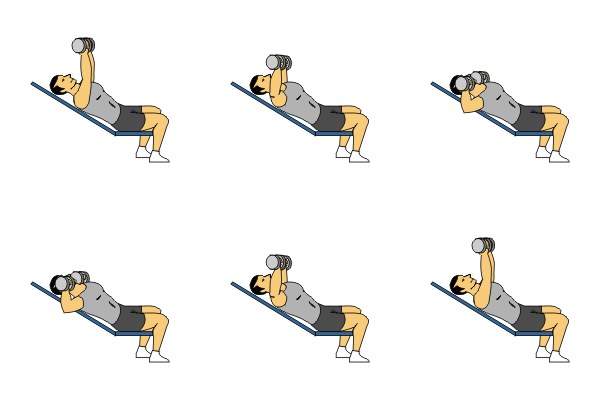
1. Adjust bench to an incline of 30 to 45 degrees.2. Repeat as above.
Flat Chest Flies
1. Lying flat on bench, hold dumbbells directly above chest. 2. Bend elbows slightly and maintain throughout the exercise.
3. Open arms to sides. Elbows should remain 'locked' in a slightly flexed position.
4. When upper arms are parallel to floor, return the weights to the starting position and repeat.
Incline Chest Flies
1. Adjust bench to an incline of 30 to 45 degrees.2. Repeat as above.
Shoulder Dumbbell Exercises
Seated Shoulder Presses
1. Sit upright on bench with dumbbells over head. Make sure back is flat.not 2. Lower dumbbells slowly to shoulders.
3. When arms are at 90 degrees, press the dumbbells back up and repeat.
Lateral Raises
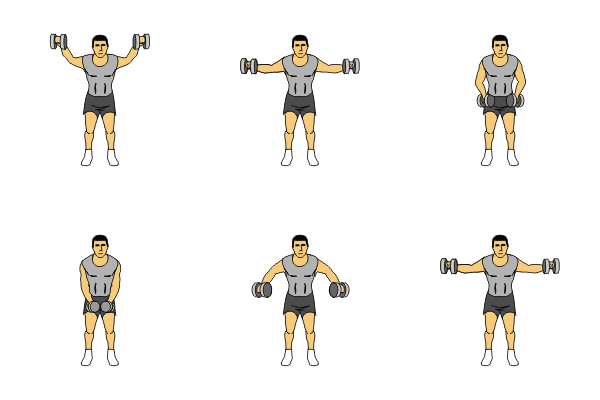
1. Stand upright, knees slightly bent, shoulder width apart, holding dumbbells at sides.2. Bend elbows slightly and raise the dumbbells out to sides. Keep elbows slightly bent throughout.
3. When arms are parallel to floor, slowly lower back and repeat.
Reverse Flies
1. Sit on edge of bench, feet flat on the floor. Bend over so chest is almost resting on thighs.2. Hold dumbbells next to feet and bend arms slightly. Open arms out keeping elbows bent.
3. When arms are parallel to floor, slowly lower dumbbells back.
Front Raises
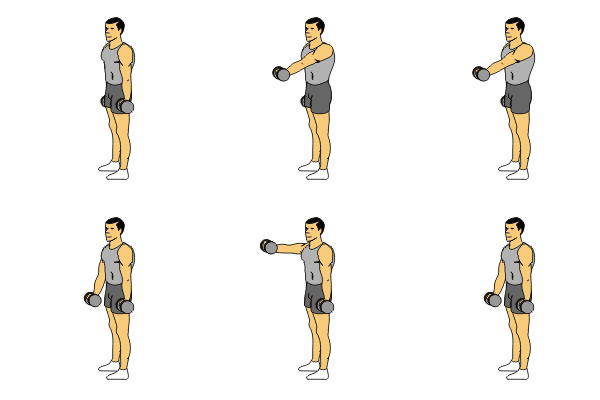
1. Stand upright, knees slightly bent, shoulder width apart. Palms should be towards thighs.2. Raise one dumbbell directly in front of you.
3. When arm is parallel to ground lower dumbbell slowly back. Repeat with the other arm.
Back Dumbbell Exercises
Dead Lifts
1. Stand upright, feet shoulder width apart, knees slightly bent.2. Bend lower back and knees to lower the weights down your legs. Back must remain flat, lower back should be arched inwards slightly. Keep head up throughout exercise.
3. Stand upright using lower back and legs, maintaining flat back and keeping your head up.
Single Arm Row
1. Stand upright next to bench. Place one knee and hand on bench. Upper body should be parallel to floor.2. Hold one dumbbell with arm extended.
3. Raise dumbbell up to your midsection keeping back still throughout movement.
4. Slowly lower dumbbell to start position and repeat. After desired number of reps repeat for other arm.
Lying Bent Over Rows
1.
Lie face down on a flat or slightly inclined bench. Hold two dumbbells
and let arms hang down. 2. Pull dumbbells up towards chest.3. Slowly lower dumbbells back down and repeat.
Trapezius Dumbbell Exercises
Upright Rows
1. Stand upright, feet shoulder width apart, knees slightly bent. 2. Keeping dumbbells close to body, raise them to chin.
3. Hold for a count of 2 and slowly lower to start position and repeat.
Shrugs
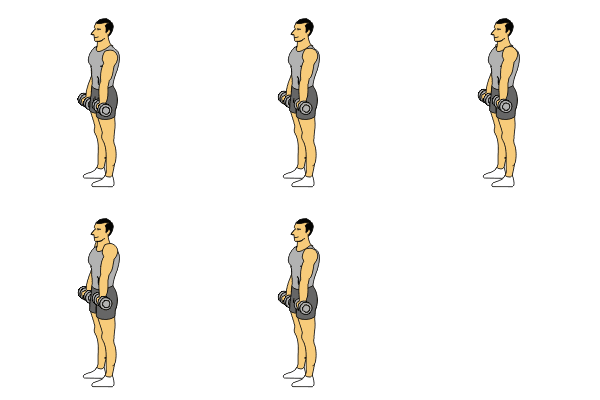
1. Stand upright, feet shoulder width apart, knees slightly bent. 2. Keeping arms straight 'shrug' shoulders as high as possible and hold for a count of 3.
3. Relax and repeat.
4. Do not roll shoulders backwards as you shrug up.
Biceps Dumbbell Exercises
Decline Seated Bicep Curls
1. Adjust bench to a 45 degree incline.2. Hold dumbbells at sides. Arms should be fully extended.
3. Keep elbows close to body and curl weight up by bending elblows.
4. Slowly lower dumbbells and repeat.
Hammer curls
1. Stand upright with dumbells at sides.2. Turn palms inward so they face body.
3. Curl dumbbells up slowly keeping your elbows close to sides.
Preacher Curls
1. Set bench so back rest is approx 45 degrees.2. Stand behind the bench. Holding dumbbell rest back of upper arm on back rest, arm fully extended.
3. Keep back of upper arm against back rest and curl dumbbell up towards face.
4. Slowly lower dumbbell until arm is not quite fully extended and repeat for desired number of reps before switching arms.
Concentration Curls
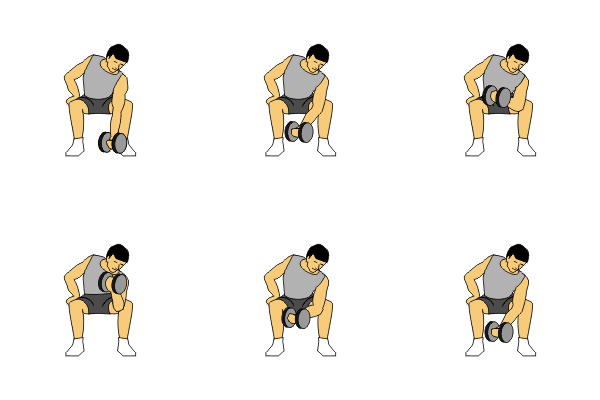
1. Sit on edge of bench with feet flat on the floor.2. Holding dumbbell place elbow on inside of thigh, just above knee.
3. Curl dumbbell up towards your face. Do not swing back as you lift the weight.
4. Slowly lower the weight and repeat for desired number of reps before switching arms.
Triceps Dumbbell Exercises
Overhead Triceps Extensions
1. Stand upright, feet shoulder width apart.2. Hold dumbbell directly above head with arm fully extended. Clasp elbow with free hand for support.
3. Slowly let elbow fold so dumbbell is lowered behind head. 4. Extend arm back to starting position. Repeat for the desired number of reps and switch arms.
French Presses
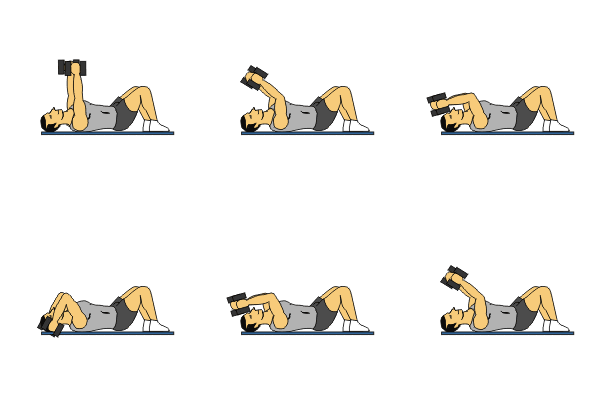
1.
Lie flat on bench. Hold dumbbells directly above chest with palms
facing each other. Dumbbells should be just about touching each other.2. Keeping your shoulders locked, let your elbows fold so dumbbells are lowered down to either side of head.
3. Extend both your arms back to start position and repeat.
Triceps Kickbacks
1. Stand upright next to bench. Place one arm and leg on bench. Upper body should be parallel to ground.2. Holding dumbbell raise elbow so upper arm is parallel to ground. Elbow should be bent at right angles.
3. Extend elbow so entire arm is parallel to ground.
4. Slowly return to start position and repeat for desired number of reps before changing arms.
Leg Dumbbell Exercises
Half Squats
1. Holding dumbbells at sides, stand upright with your feet shoulder width apart.2. Bend from knees until thighs are almost parallel to the ground (avoid letting knees turn inwards).
3. Keep back flat, lower back slightly arched inwards and head up.
4. Return to upright position and repeat.
Dumbbell Lunges
1. Holding dumbbells at sides, stand upright with feet slightly less than shoulder width apart.2. Step forward about 2 feet with one foot and bend knee to about 90 degrees. As you plant your foot bend trailing knee so it nearly touches floor.
3. Push off with front foot to return to starting position.
4. Repeat for the desired number of reps and change legs.
Calf Dumbbell Exercises
Single Leg Calf Presses1. Set the back rest to upright position. Holding dumbbell in one hand at side, place other hand on top of bench for support.
2. Stand on one foot on edge of bench frame.
3. Stand up on tip toe using free hand to balance yourself. Do not to push yourself up with your hand.
4. Slowly lower yourself to the ground and repeat for desired number of reps before changing legs.
Seated Calf Raises
Friday, August 31, 2012
Lift weights or Skip It?
Scientists have discovered the elixir of youth - except it isn't an elixir at all.
One of the things that makes people feel old is that their muscles get weak, they get clapped out. It's called sarcopaenia, and it's one of the reasons why elderly people end up in nursing homes or under major care.
Scientists have discovered that one of the reasons for this muscle weakness is that the energy factories inside cells – mitochondria – become clapped out themselves, they become damaged by free radicals.
Researchers have found a way of reviving mitochondria but it's actually a way of hoovering them up. They've found that if you stress muscle, the muscle hoovers up old mitochondria and replaces them with new ones.
And one of the best ways of stressing muscle is actually progressive weight training, and it seems to work. They also found that if you added the performance-enhancing compound creatine to the training people's muscles performed even better.
What they haven't discovered is how to fix up the mitochondria in wrinkles, but when they do, I'll be the first to tell you about it.
Wednesday, June 20, 2012
10 good reasons why women should stay away from weights
Put it down, woman!
1. You might break a nail.2. You could even bruise a male ego or two.
3. You’ll eat properly and still be able to lose fat. Work of the devil!
4. You’ll look more like an athlete and less like a runway model. Skeletal is sexy, right?
5. You’ll be able to lift heavy things without asking a man for help, thus upsetting the balance of the universe.
6. You will be seen in public without high heels.
7. You’ll grunt, sweat and feel sore. So unladylike!
8. You’ll be proud of your pert bum instead of being self conscious about it like a normal woman.
9. You’ll be more active and confident instead of sitting around looking pretty. What are you, some kind of feminist?
10. You’ll be stronger, leaner and sexier – and we all know where that can lead!
Subscribe to:
Posts (Atom)


